
 Admin
Admin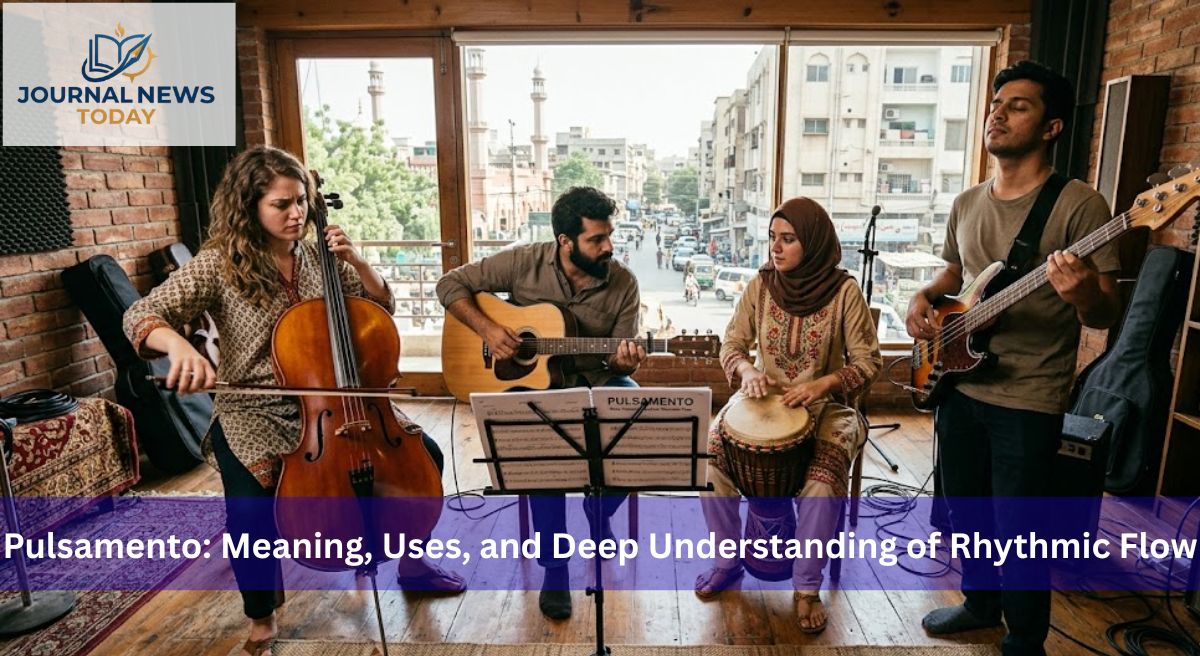
Pulsamento is a term that carries a sense of rhythm, movement, and repeated energy flow. It is often associated with ideas of pulsation, vibration, and structured beats that can be found in music, biology, physics, and even emotional experiences. At its core, pulsamento represents something that is never completely still; instead, it moves in a continuous cycle of expansion and contraction, presence and pause, intensity and release.
In everyday understanding, the concept can be linked to the natural rhythm of life. The heartbeat is one of the most basic examples, where the body follows a consistent pattern of pulses that sustain life. Similarly, in music, rhythm depends heavily on controlled pulses that create structure and feeling. Without this underlying pulse, sound would feel random and disconnected. This is why pulsamento is often described as the invisible framework that supports flow and harmony in different systems.
Beyond science and music, pulsamento also carries a symbolic meaning. It reflects emotional rhythms, such as excitement, stress, calmness, and anticipation. Human emotions often rise and fall in waves, much like a pulse. This makes the concept widely applicable across disciplines, from artistic expression to biological systems. Understanding pulsamento helps us recognize patterns that shape both natural and human-made environments.
The Origin and Linguistic Background of Pulsamento
The word pulsamento is derived from Romance language roots, closely connected to terms like “pulse” and “pulsation.” It shares linguistic ties with Latin-based vocabulary that describes rhythmic movement and repeated force. Over time, the term has been used in different cultural and academic contexts to represent structured rhythmic energy.
In music theory, especially within classical and contemporary traditions, pulsamento is often used to describe the underlying beat or steady pulse that guides timing. Musicians rely on this internal structure to maintain rhythm and coordination. Without it, compositions would lose coherence, making performance difficult to follow or interpret.
In scientific discussions, the term is sometimes used in a broader sense to describe oscillations or periodic motion. This includes everything from sound waves to biological rhythms. The idea is consistent: pulsamento represents a measurable or perceivable repetition of movement over time.
Understanding its linguistic and conceptual roots helps in appreciating how widely the idea has spread across fields. It is not just a technical term but also a descriptive way of understanding patterns in life and nature.
Pulsamento in Music and Rhythmic Structure
One of the most important areas where pulsamento plays a key role is music. Every musical composition relies on rhythm, and rhythm is built upon a steady pulse. This pulse acts as the foundation that allows melodies and harmonies to develop in an organized way. Without it, music would lose direction and emotional impact.
In practical terms, musicians often feel pulsamento rather than consciously analyze it. It is the internal beat that guides timing, whether in drumming, singing, or playing instruments. This is especially important in group performances where synchronization is essential. Each performer must align with the shared pulse to create a unified sound.
Different musical genres emphasize pulsamento in unique ways. For example, classical music may use subtle and controlled pulses, while electronic or dance music often highlights strong and repetitive beats. In both cases, the underlying principle remains the same: rhythm depends on a consistent and perceivable flow of energy.
Even silence in music is influenced by pulsamento. Pauses are structured around the expected return of the beat, creating tension and release. This dynamic interaction between sound and silence gives music its emotional depth and complexity.
Biological Rhythms and Natural Pulsamento
In biology, pulsamento can be observed in many natural processes that sustain life. The most obvious example is the human heartbeat, which follows a rhythmic cycle of contraction and relaxation. This pulse ensures that oxygen and nutrients are circulated throughout the body.
Respiration is another example of natural pulsamento. Breathing follows a rhythmic pattern that balances oxygen intake and carbon dioxide release. Even when we are not consciously aware of it, this process continues in a structured cycle that maintains life stability.
Beyond humans, pulsamento exists in nature at multiple levels. Plants exhibit rhythmic behaviors such as opening and closing of leaves, while animals often follow circadian rhythms influenced by environmental cycles like day and night. These biological patterns demonstrate that pulsamento is not limited to sound or movement but is deeply embedded in life itself.
At a cellular level, oscillations and cycles regulate essential biological functions. These microscopic pulses ensure that systems remain balanced and responsive to changes. The idea of pulsamento in biology highlights the importance of rhythm in maintaining stability and adaptability.
Psychological and Emotional Dimensions of Pulsamento
Pulsamento is not only a physical or biological concept; it also has psychological significance. Human emotions often move in cycles rather than remaining constant. Feelings such as happiness, anxiety, excitement, and calmness can rise and fall in patterns that resemble rhythmic pulses.
This emotional pulsamento can be influenced by external events, internal thoughts, and even environmental conditions. For example, stress may create a rapid emotional pulse, while relaxation produces a slower and more stable rhythm. Understanding these patterns can help individuals become more aware of their emotional states.
In psychology, rhythmic awareness is sometimes used in therapeutic practices. Techniques involving breathing exercises, meditation, and sound therapy rely on controlling or observing internal rhythms. These methods help individuals stabilize emotional fluctuations and achieve mental balance.
Creative expression is also deeply connected to emotional pulsamento. Writers, artists, and musicians often translate emotional rhythms into their work. This allows abstract feelings to take shape in structured and meaningful forms. The connection between emotion and rhythm shows how deeply pulsamento influences human experience.
Pulsamento in Physics and Wave Dynamics
In physics, pulsamento can be associated with wave behavior, oscillations, and periodic motion. Many natural phenomena operate in cycles that repeat over time, such as sound waves, light waves, and mechanical vibrations.
A key idea in wave physics is that energy often travels in pulses or oscillations. These movements can be measured in frequency, amplitude, and wavelength. The repetition of these patterns reflects the concept of pulsamento at a scientific level.
Sound, for example, is created through vibrations that travel in rhythmic waves. These waves are interpreted by the human ear as tone and rhythm. The consistency of these vibrations determines how sound is perceived, whether as music, speech, or noise.
Even in advanced physics, pulsating systems appear in quantum mechanics and electromagnetic theory. Particles and energy fields often behave in oscillatory ways, reinforcing the idea that rhythm is a fundamental property of the universe.
The Role of Pulsamento in Human Creativity and Expression
Human creativity is deeply influenced by rhythmic structure. Whether in music, dance, literature, or visual arts, pulsamento acts as a guiding principle that shapes expression. Artists often rely on internal rhythm to organize ideas and create flow within their work.
In dance, for example, movement is directly connected to musical pulse. Dancers interpret rhythm through motion, translating auditory signals into physical expression. This creates a visual representation of pulsamento that audiences can experience directly.
In writing, rhythm is present in sentence structure, pacing, and emotional progression. A well-written text often follows a subtle pulse that guides the reader through ideas smoothly. This invisible rhythm enhances readability and emotional impact.
Even visual arts can reflect pulsamento through repetition, symmetry, and flow. Patterns and structures within artwork often create a sense of movement, guiding the viewer’s attention in a rhythmic way. This demonstrates how deeply the concept is embedded in all forms of creativity.
Conclusion
Pulsamento is a universal concept that appears across multiple disciplines, from science and biology to music and psychology. It represents the idea that everything in existence moves in patterns, cycles, and rhythms. These patterns create structure, balance, and meaning in both natural and human-made systems.
Understanding pulsamento allows us to recognize the hidden rhythms that shape life. Whether it is the heartbeat sustaining the body, the beat guiding music, or emotional cycles influencing behavior, rhythm is always present. It is not just a technical concept but a way of observing how the world functions at every level.
By becoming more aware of these patterns, we can better understand ourselves and the environment around us. Pulsamento reminds us that nothing exists in complete stillness; everything moves, flows, and evolves in rhythm.


